
Water Softener Installation in California
White scale on everything? Spots on dishes? Dry skin after every shower? Appliances dying young? That is California hard water, and it is costing you $800-$1,500 a year. We test your water free, size your system correctly, and install professional-grade softeners across the state.
Get Your Free Quote
60 seconds · No obligation · Upfront pricing
Is Your Water Hard? Almost Certainly Yes.
Here is something most Californians do not realize: the vast majority of California has hard to very hard water. The state sits on mineral-rich geology, and municipal water picks up calcium and magnesium on its way to your tap. Some areas are extreme:
- Very hard (180+ ppm / 10.5+ gpg): Much of the Inland Empire, Central Valley, parts of San Diego County, high desert communities. Some wells test at 300-500+ ppm.
- Hard (120-180 ppm): Large parts of Los Angeles, Orange County, the Bay Area peninsula, Sacramento Valley.
- Moderately hard (60-120 ppm): Some coastal areas, parts of San Francisco, areas with mixed water sources.
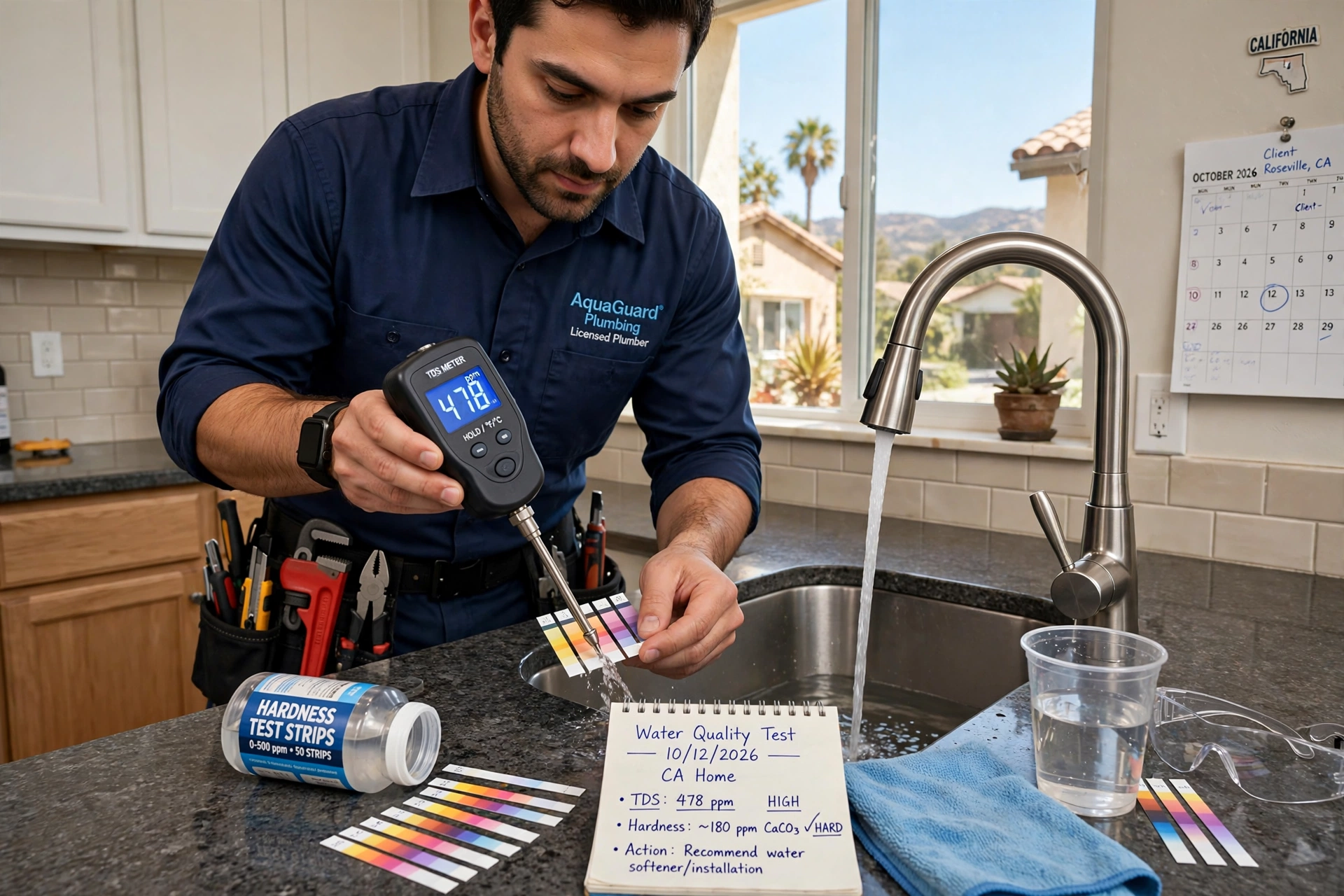
How to know your number: we test on every visit with a digital TDS meter and hardness strips, free with any service call. Or check your water utility annual Consumer Confidence Report, which lists hardness. Or look at the evidence in your home: white scale on faucets, spots on glassware, stiff laundry, dry skin after showering, soap that does not lather well. If you see these, your water is hard.
The 60-second test: Fill a clear bottle one-third with tap water, add a few drops of pure liquid soap (not detergent), and shake. Soft water produces fluffy, long-lasting suds. Hard water produces a thin, milky layer that disappears quickly, with white particles floating. It is crude but surprisingly accurate.
What Hard Water Does to Your Home (The Expensive Part)
Hard water is not a health hazard. It is an everything else hazard. Here is the damage I see daily:
Water heaters die young. Scale coats the heating elements (electric) or the tank bottom (gas), forcing the unit to work harder. A water heater that should last 12-15 years dies in 7-9 in very hard water. I have opened heaters with 6 inches of rock-like sediment in the bottom. Every water heater replacement I do in hard water areas, I recommend a softener to protect the new unit.
Pipes narrow from the inside. Scale buildup reduces pipe diameter over time, cutting flow and increasing pressure on joints. In extreme cases, I have seen half-inch copper reduced to a quarter-inch opening. This is irreversible without repiping.
Fixtures and appliances fail early. Dishwashers, washing machines, coffee makers, ice makers, and faucets all suffer. Scale clogs valves, damages seals, and coats heating elements. Appliance lifespan drops 30-50% in very hard water.
Your skin and hair suffer. Hard water leaves mineral residue on skin (dryness, irritation, eczema flare-ups) and hair (dullness, buildup, color fading). This is the complaint I hear most from homeowners after they get a softener: “I cannot believe the difference in the shower.”
Cleaning takes more effort and product. Soap does not lather, so you use more. Spots on dishes require rewashing or special rinse aids. Scale on shower doors needs acid cleaners. Laundry needs more detergent and still comes out stiff and dull.
The real cost: Between premature appliance replacement, extra energy, extra cleaning products, and plumbing repairs, very hard water costs the average household $800-$1,500 per year in hidden costs. A softener pays for itself.
How Water Softeners Work (No Magic, Just Chemistry)
A water softener is an ion exchange system. Here is the simple version:
Hard water flows through a tank filled with resin beads. These beads are charged with sodium (or potassium) ions. As water passes through, the resin grabs the calcium and magnesium ions (the hardness) and releases sodium ions in exchange. The water coming out has the hardness minerals removed.
Eventually the resin gets saturated with hardness minerals. Then the system regenerates: it flushes the resin with a concentrated salt brine, which strips off the accumulated hardness and recharges the beads with sodium. The waste brine goes down the drain. The cycle repeats automatically, usually at 2 AM when you are not using water.
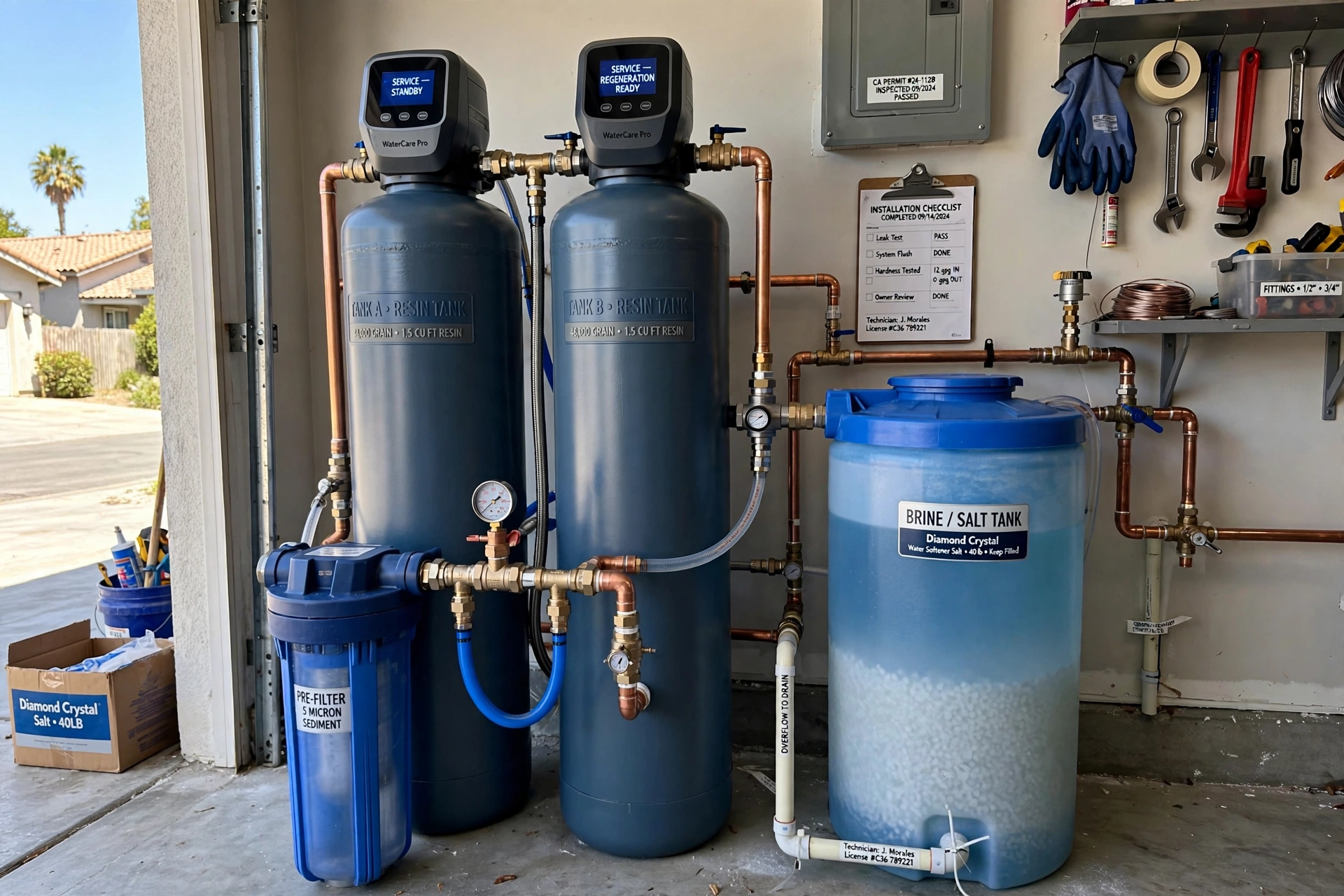
Key components: the resin tank (where softening happens), the brine tank (holds the salt), and the control valve (the brain that manages regeneration timing). Quality matters most in the control valve. A good digital metered valve regenerates based on actual water usage. A cheap timer valve regenerates on a fixed schedule whether you need it or not, wasting salt and water.
About the salt: Yes, softened water contains a small amount of sodium. For most people this is negligible (less than a slice of bread per day from drinking water). If sodium is a medical concern, potassium chloride can be used instead of sodium chloride, or we can plumb a bypass for the kitchen cold water tap so your drinking water stays unsoftened. Many of our installations include a dedicated hard-water drinking tap for exactly this reason.
Sizing and Selecting: What Actually Matters
Softeners are sized by grain capacity: 24,000, 32,000, 48,000, 64,000, 80,000+ grains. Bigger is not automatically better. Here is how proper sizing works:
The formula: Daily water usage (gallons) x hardness (grains per gallon) x days between regeneration = required capacity. A family of four using 300 gallons/day with 15 gpg hardness needs about 31,500 grains per week. A 48,000-grain unit regenerating weekly is about right.
Oversizing wastes money. Too large, and the system regenerates infrequently, which can allow channeling in the resin bed and actually reduce efficiency. It also costs more upfront for no benefit.
Undersizing wastes salt and water. Too small, and it regenerates constantly, burning through salt and sending excess water down the drain.
We size based on your actual hardness test, household size, and water usage patterns. Not a guess, not a one-size-fits-all.
What to look for: Demand-initiated (metered) regeneration, not timer-based. High-efficiency resin. A reputable control valve (Fleck, Clack). NSF certification. Bypass valve included (essential for maintenance). Adequate grain capacity for your household with some headroom.
What to avoid: Magnetic or electronic “descalers” that claim to soften without salt. They do not remove hardness minerals. They may reduce some scale adhesion, but the minerals are still in your water, still flowing through your pipes and appliances. If it sounds too good to be true, it is.
Installation: What to Expect
Whole-house softener installation typically takes 3-5 hours. Here is the process:
- Location assessment. The softener goes where the main water line enters the house, usually the garage. We need a drain nearby for regeneration discharge, an electrical outlet for the control valve, and enough space for the tanks plus salt access.
- Main line cut-in. We cut into the main water line and install the bypass valve assembly. This lets water flow through the softener normally, or bypass it entirely for maintenance.
- Plumbing connections. Inlet and outlet connections with proper fittings. We use quality materials rated for the pressure.
- Drain line. The regeneration discharge needs an approved drain connection with an air gap (California code requirement to prevent cross-contamination).
- Programming. We set the control valve based on your tested hardness, household size, and water usage. This is the step that separates professional installation from DIY. Wrong settings mean poor performance or wasted salt.
- Testing and walkthrough. We test the softened water, show you how to add salt, explain the regeneration cycle, and set expectations for the transition period.
The transition: Existing scale in your pipes and water heater will gradually dissolve over the first few weeks of soft water. You may notice some discoloration initially as old scale flushes out. This is normal and temporary. Your water heater will actually become more efficient as the scale clears.
Ongoing Costs: Salt, Water, and Maintenance
Honest ongoing cost breakdown:
- Salt: $5-$10/month for most households. A 40-lb bag costs $6-$8 and lasts 4-8 weeks depending on usage and hardness.
- Water for regeneration: 30-80 gallons per regeneration, typically 1-2 times per week. Adds roughly $3-$8/month to the water bill.
- Electricity: Negligible. The control valve uses minimal power.
- Annual service (recommended): $150-$250 for resin bed cleaning, valve inspection, and settings optimization. Extends system life significantly.
- Resin lifespan: 10-15 years with proper maintenance. Resin replacement ($600-$1,200) is cheaper than a new system.
Total annual operating cost: roughly $150-$300. Compare that to the $800-$1,500/year that hard water costs you in appliance wear, energy waste, and cleaning products. The math is not close.
Water Softener Costs: Honest Numbers
Professional softener installation is an investment that pays for itself. Real pricing:
- Water hardness test: Free with any service visit, or $49 standalone.
- Complete installation (48,000 grain, metered): $1,800-$3,000 depending on location complexity.
- Larger systems (64,000-80,000 grain): $2,500-$4,000.
- Premium high-efficiency systems: $3,000-$5,000.
- Annual operating cost (salt + water + service): $150-$300/year.
- Annual maintenance visit: $150-$250 (recommended).
Compare $150-$300/year operating cost to the $800-$1,500/year that hard water costs you. Most systems pay for themselves in 2-3 years through extended appliance life alone.
Water Softener FAQs
Is softened water safe to drink?
Yes. The sodium added is minimal, roughly equivalent to a slice of bread per day from drinking water. If sodium is a medical concern, we can use potassium chloride instead, or plumb a bypass so your kitchen cold tap stays unsoftened. Many installations include a dedicated drinking water tap.
Will a softener help my dry skin and dull hair?
This is the benefit homeowners notice first and comment on most. Soft water rinses soap completely instead of leaving mineral residue. Most people report noticeably softer skin and more manageable hair within the first week.
How often do I need to add salt?
Check monthly, add as needed. A 40-lb bag ($6-$8) typically lasts 4-8 weeks for an average household. The brine tank should always have visible salt above the water line. We will show you exactly what to look for during installation.
Do those salt-free magnetic descalers work?
They do not remove hardness minerals from water. They may reduce some scale adhesion, but the calcium and magnesium are still flowing through your pipes, water heater, and appliances. For real protection, ion exchange (salt-based) or template-assisted crystallization are the proven technologies.
Will soft water feel slippery?
Soft water rinses soap more completely, which can feel different, sometimes described as slippery, for the first few days. Most people adjust within a week and then prefer it. It is actually the feeling of truly clean skin without mineral residue.
Can I take my softener with me if I move?
Yes, softeners can be uninstalled and reinstalled, though there is labor cost involved. Many homeowners leave it as a selling feature. A water softener is actually a documented value-add in hard water areas of California.
Test Your Water Free. Fix It For Good.
Free hardness testing, correct sizing, professional installation. Serving all of California.
Licensed C-36 • Free Water Testing • Upfront Pricing