
Leak Detection in California
Water bill suddenly doubled? Got an alert from your water company? Damp spots, musty smells, or the sound of running water when nothing’s on? Our licensed plumbers find hidden leaks with electronic acoustic equipment and thermal imaging — no guesswork, no unnecessary demolition.
Get Your Free Quote
60 seconds · No obligation · Upfront pricing
Your Water Bill Was $507 Last Month. Here’s Why That’s a Leak.
The single most common way hidden leaks get discovered in California isn’t a puddle — it’s the water bill. You open it, do a double-take, and wonder if there’s been a mistake. There usually hasn’t. Or maybe your water company sent you one of those “possible leak” alerts — high usage notifications, a door hanger, a letter about continuous flow at your meter.
Here’s what most homeowners don’t realize: a leak the thickness of a pencil lead can waste thousands of gallons a month. A running toilet can waste 200+ gallons a day without making a sound you notice. A pinhole leak in a slab line can run for months, silently undermining your foundation, before any visible sign appears. By the time you see water, the leak has been there a while.
So if your bill spiked and your usage didn’t change — if the water company is telling you something’s wrong — believe them. The meter doesn’t lie. What you need now isn’t a guess; it’s a professional with the right equipment to find exactly where that water is going.
The 2-Minute Meter Test (Do This Right Now)
Before you call anyone, here’s the test every plumber wishes homeowners knew. It takes two minutes and tells you definitively whether you have a leak:
- Turn off everything that uses water — faucets, washing machine, dishwasher, irrigation, ice maker. Everything.
- Find your water meter — usually in a ground box near the street or sidewalk. Lift the lid (a screwdriver helps).
- Look at the dial. Most meters have a small triangle or star-shaped leak indicator. If it’s moving — even slowly — with everything off, water is flowing somewhere it shouldn’t be.
- Write down the reading, wait 30 minutes (don’t use any water), and read it again. Any change confirms a leak.
If the meter is moving, you have a leak. If it’s moving fast, it’s significant. Now the question is where — and that’s our job. Call us and tell us what the meter showed; it helps us come prepared.
One more check: if you have a shut-off valve where the water enters your house, close it and check the meter again. If the meter stops, the leak is inside your house. If it keeps moving, the leak is in the service line between the meter and your house. That one distinction saves diagnostic time.
“Do You Have the Machines to Actually Find It?”
This is the question I hear on almost every leak detection call, and it’s exactly the right question. Because here’s the dirty secret of our industry: some companies “detect” leaks by cutting holes in your drywall until they find water. That’s not detection — that’s demolition with extra steps.
Professional electronic leak detection is a completely different discipline. Here’s what we bring:
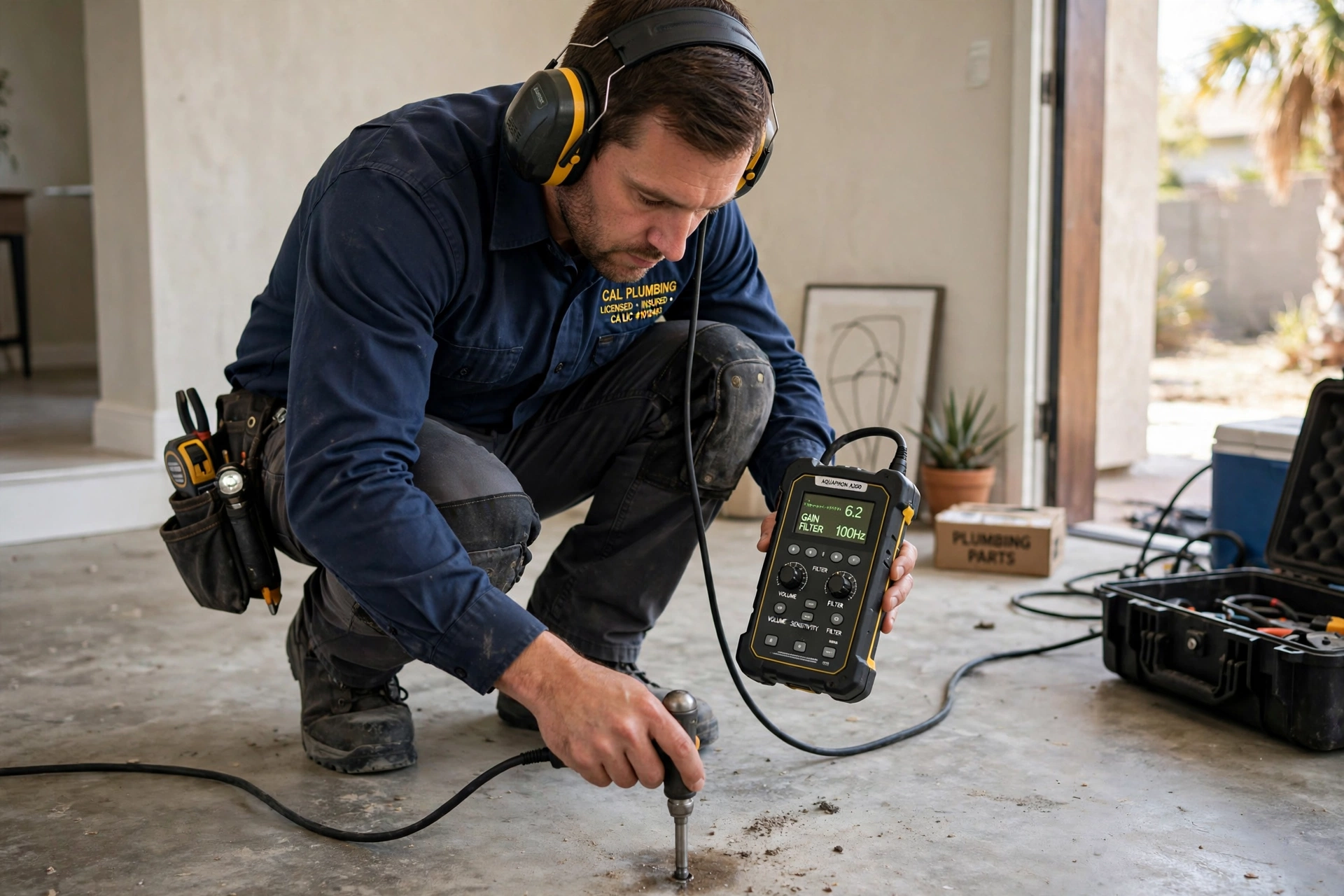
- Acoustic listening equipment — highly sensitive ground microphones and headphones that amplify the sound of water escaping a pressurized pipe. A trained technician can distinguish a leak’s signature from background noise and triangulate its position — often within inches. This is the primary tool for slab and underground leaks.
- Thermal imaging cameras — detect temperature differences in walls and floors. A hot water line leak shows up as a warm signature; a cold line leak shows as cool. We can scan entire walls without touching them.
- Moisture meters — pin and pinless meters that measure moisture content in drywall, wood, and concrete. They map how far water has spread, which tells us both the leak location and the extent of damage.
- Pressure testing equipment — we can isolate sections of your plumbing and pressure-test them individually. If the hot side holds pressure but the cold side drops, we’ve just eliminated half your house.
- Endoscopic cameras — tiny cameras that go through a half-inch hole to visually confirm what’s inside a wall cavity before we open it up.
- Helium and tracer gas detection — for the truly difficult cases, we can introduce safe tracer gas into the line and detect where it escapes. Extremely precise.
The goal is always the same: one hole, in the right place. Not exploratory demolition across three rooms.

Where California Homes Hide Their Leaks
After thousands of leak detections across the state, here are the usual suspects — in order of how often I find them:
1. Slab leaks (under the concrete foundation). California’s slab-on-grade construction plus hard water plus copper pipe is a recipe for pinhole leaks. Signs: hot spots on the floor, warm flooring in one area, the sound of running water when nothing’s on, cracks in tile or flooring, or a water heater that runs constantly. Slab leaks are the most damaging because they’re invisible the longest.
2. Toilet flappers and fill valves. The most common indoor leak by far — and the most wasteful. A deteriorated flapper lets water silently flow from tank to bowl, 24/7. Put food coloring in the tank; if color appears in the bowl without flushing, you’ve found it. Wastes up to 200 gallons a day.
3. Supply lines to fixtures. Those braided hoses under sinks and behind toilets, washing machine hoses, refrigerator ice-maker lines. They develop slow drips at connections that soak cabinets and walls for months before anyone notices.
4. Shower and tub waterproofing failures. Not a pipe leak at all — the tile grout or caulking fails, water gets behind the tile, and rots the wall from the inside. Shows up as musty smell, soft drywall, or peeling paint near the shower.
5. Irrigation system leaks. In California’s landscaping-heavy yards, broken sprinkler heads, cracked valves, and split lateral lines waste enormous amounts of water. If your bill spikes in summer, check the irrigation before assuming it’s indoors.
6. Water heater and softener connections. Corroded fittings, failing T&P valves, and softener drain lines that run constantly.
7. Service line (meter to house). Older galvanized or polybutylene service lines corrode and split underground. Signs: soggy patches in the yard between the meter and house, or the meter test showing flow with the house valve closed.

Leak Detection Costs — Honest Numbers
Price is the first thing everyone asks about, so let’s be direct:
- Electronic leak detection service: $250–$600 depending on complexity. This covers the full diagnostic — acoustic, thermal, moisture mapping, and a written report with the leak location marked.
- Detection + repair (most common): Most leak jobs total $500–$1,500 including the repair once we’ve found it. Slab leak reroutes run higher.
- Slab leak repair options: Spot repair through the slab ($1,000–$3,000) vs. overhead reroute ($2,500–$6,000). Rerouting abandons the leaking under-slab line and runs new pipe through walls/attic — no jackhammering your foundation, and it eliminates future slab leaks on that line.
- Service line replacement: $2,000–$6,000 depending on length and depth.
What I want you to know: we charge for detection as a standalone service, and that’s actually in your favor. Some companies offer “free leak detection” — but then you’re locked into their repair quote with no independent diagnosis. Our detection fee buys you an unbiased answer: here’s the leak, here’s what it needs, here’s what it costs. Get a second opinion on the repair if you want. An honest diagnosis has value on its own.
And yes — if you hire us for the repair, we credit the detection fee toward the job.
Why Leaks Happen: A Plumber’s Root-Cause View
Finding the leak is step one. Understanding why it happened prevents the next one:
Hard water corrosion. California’s mineral-heavy water is the background cause of most pipe failures. It creates pinhole leaks in copper (the minerals create tiny galvanic cells that eat through the pipe wall) and scale buildup that increases pressure on joints. If you have one pinhole leak in copper, you likely have more developing — which is why we often recommend rerouting rather than patching.
High water pressure. Anything over 80 PSI stresses every joint, valve, and appliance connection in your house. Many California homes sit at 90–110 PSI because of municipal supply pressure. A $200 pressure regulator and an expansion tank prevent an enormous category of leaks. We check your pressure on every visit — it’s a 30-second test.
Age and material. Galvanized steel (pre-1970s) corrodes from the inside out. Polybutylene (70s–90s) becomes brittle and fails catastrophically. Even copper has a lifespan — 40–50 years in hard water areas. If your home’s plumbing is original and 40+ years old, leaks aren’t bad luck; they’re scheduled maintenance you didn’t schedule.
Foundation movement. Expansive clay soils, minor seismic shifting, and settling all stress rigid pipe — especially where pipes pass through the slab. This is why slab leaks cluster in certain California neighborhoods with reactive soil.
Poor original installation. Kinked lines, over-tightened fittings, pipes rubbing against concrete or framing without protection — installation defects take years to manifest as leaks, but they always do eventually.
The DIY Reality Check
Here’s what you can legitimately do yourself: the meter test (described above), the toilet dye test, checking under sinks with a flashlight, listening for running water at night when the house is quiet, and looking at your water bill every month. These are genuinely useful and every homeowner should know them.
Here’s what you can’t do: pinpoint a slab leak with a stethoscope app, find a leak inside a wall without moisture mapping, or distinguish between a supply leak and a drain leak by symptoms alone. I’ve seen homeowners cut four holes in drywall chasing a leak that was actually coming from the bathroom above — a $2,000 drywall repair bill on top of the plumbing fix.
And please don’t ignore a suspected leak because “it’s just a small drip.” Small drips inside walls become mold colonies, rotted framing, and foundation damage. Water is patient and relentless. The cheapest leak is the one you find early.
Preventing Hidden Leaks
- Read your water bill monthly. A sudden increase with no lifestyle change is the earliest warning system you have. Some California water districts offer smart meter alerts — sign up if yours does.
- Check your water pressure yearly. A $10 gauge on an outdoor hose bib tells you in 30 seconds. Over 80 PSI? Install a regulator.
- Replace washing machine hoses every 5 years. Use stainless steel braided lines, not rubber. A burst washer hose is one of the most common flood sources we see.
- Know the age of your pipes. If your home is 40+ years old with original plumbing, budget for repiping before leaks force the issue on their schedule.
- Consider a smart water shutoff. Devices that monitor flow and automatically shut off the main when they detect abnormal usage ($500–$1,000 installed) have prevented countless disasters — especially valuable for vacation homes and frequent travelers.
- Walk your property quarterly. Look for soggy spots, listen for running water, check under sinks, look at ceilings below bathrooms. Five minutes, four times a year.
Leak Detection FAQs
How much does leak detection cost?
Professional electronic leak detection runs $250–$600 depending on complexity. This includes acoustic and thermal equipment, moisture mapping, and a written report with the leak location. If you hire us for the repair, the detection fee is credited toward the job.
My water bill doubled but I don’t see any water — is that a leak?
Almost certainly. Hidden leaks — slab lines, underground service lines, running toilets — waste enormous amounts of water without any visible sign. Do the meter test described above: if the meter moves with everything off, you have a leak. Call us and we’ll find exactly where.
I’m not sure where the leak is — is that a problem?
Not at all — that’s literally what leak detection is for. Most of our customers have no idea where the leak is; they just know the bill spiked or the meter is moving. Finding it is our job, and our equipment pinpoints it without tearing your house apart.
Do you have to tear open my walls to find the leak?
No. That’s the whole point of electronic detection. Acoustic equipment, thermal imaging, and moisture meters let us pinpoint the leak location first — then we open one precise access point for the repair. No exploratory demolition.
What is a slab leak and how serious is it?
A slab leak is a leak in the water lines running under your concrete foundation. Signs include hot spots on the floor, the sound of running water, cracks in flooring, or a constantly running water heater. They’re serious because they’re invisible — they can undermine your foundation and waste thousands of gallons before detection. We locate them electronically and typically recommend rerouting the line overhead rather than jackhammering the slab.
The water company sent me a leak alert — what do I do?
Take it seriously — their smart meters detect continuous flow patterns that indicate leaks. Do the meter test to confirm, then call us. Bring the alert or your bill showing the usage spike; it helps us understand the scale of the leak before we arrive.
Can you just find the leak without doing the repair?
Yes — detection-only is a standalone service. You get the leak location marked, a written report with photos, and an honest repair estimate. Some customers get our diagnosis and handle the repair themselves or get competing quotes. That’s fine; an accurate diagnosis has standalone value.
High Water Bill? Let’s Find Where It’s Going.
Electronic leak detection with upfront pricing — no guesswork, no unnecessary demolition. Call now anywhere in California.
Licensed C-36 • Acoustic + Thermal Equipment • Upfront Pricing