
Trenchless Sewer Repair in California
Sewer line damaged but dreading a torn-up yard, driveway, and landscaping? Trenchless repair fixes your sewer line through small access points — no massive excavation. We use camera-verified pipe lining and pipe bursting to restore your line in days, not weeks, with minimal disruption to your property.
Get Your Free Quote
60 seconds · No obligation · Upfront pricing
Available 24/7 — connect with an independent local contractor

Your Sewer Line Is Broken. Your Yard Doesn’t Have to Be.
Here’s the scenario nobody wants: a plumber runs a camera down your sewer line and shows you cracks, root intrusion, or a collapsed section. Then comes the part that makes homeowners go pale — the traditional fix means excavating a trench from your house to the street. Through your lawn. Under your driveway. Past your landscaping. Thousands in restoration costs on top of the repair itself.
Trenchless sewer repair changes that equation entirely. Instead of digging up the old pipe, we rehabilitate it from the inside — through one or two small access points. Your driveway stays intact. Your landscaping survives. The job finishes in 1-3 days instead of 1-2 weeks. And the new pipe-within-a-pipe often outlasts the original.
But trenchless isn’t magic, and it’s not right for every situation. Let me explain exactly how it works, when it’s the right call, and when traditional excavation is actually the honest recommendation.
How Trenchless Sewer Repair Actually Works
There are two main trenchless methods, and they solve different problems:
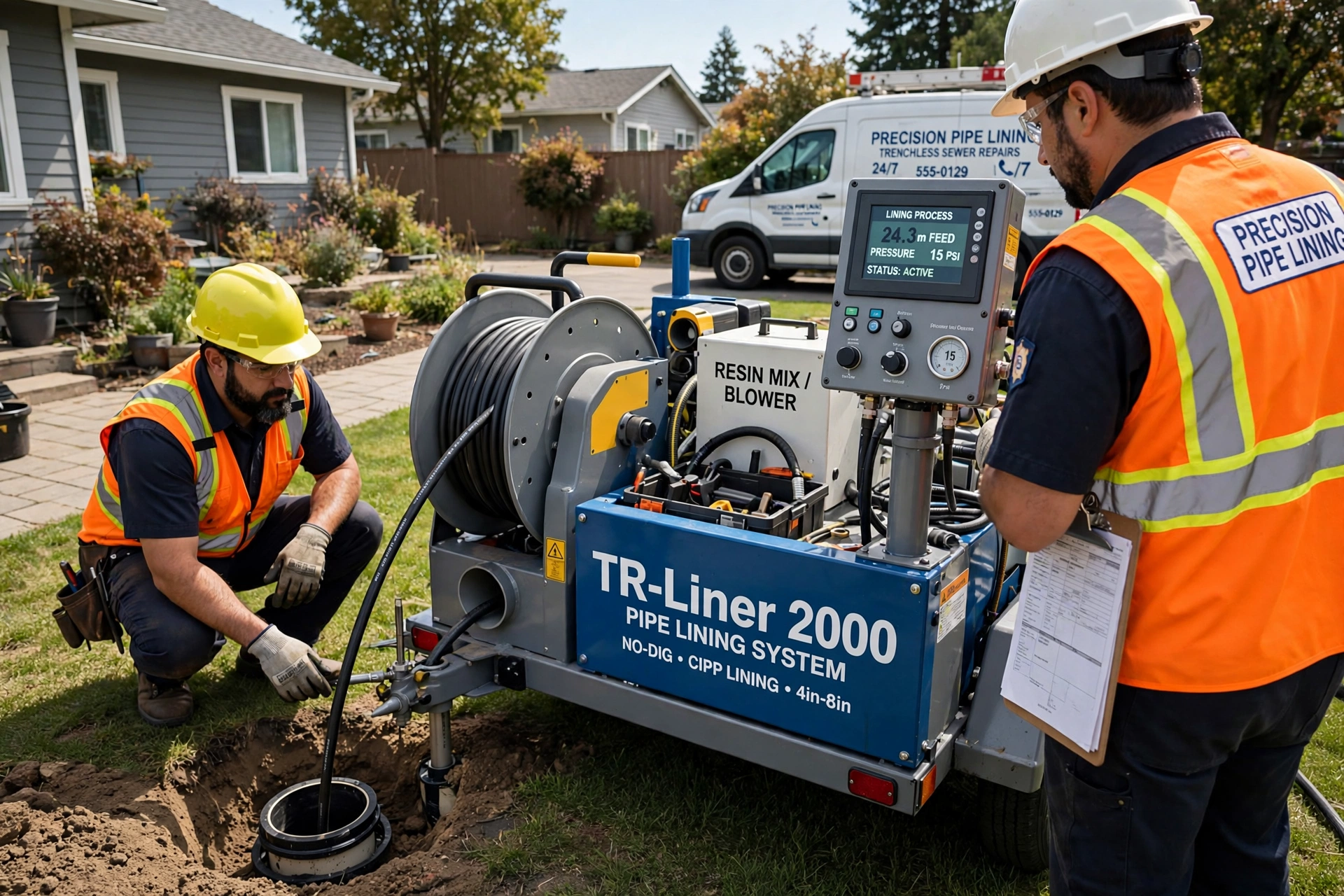
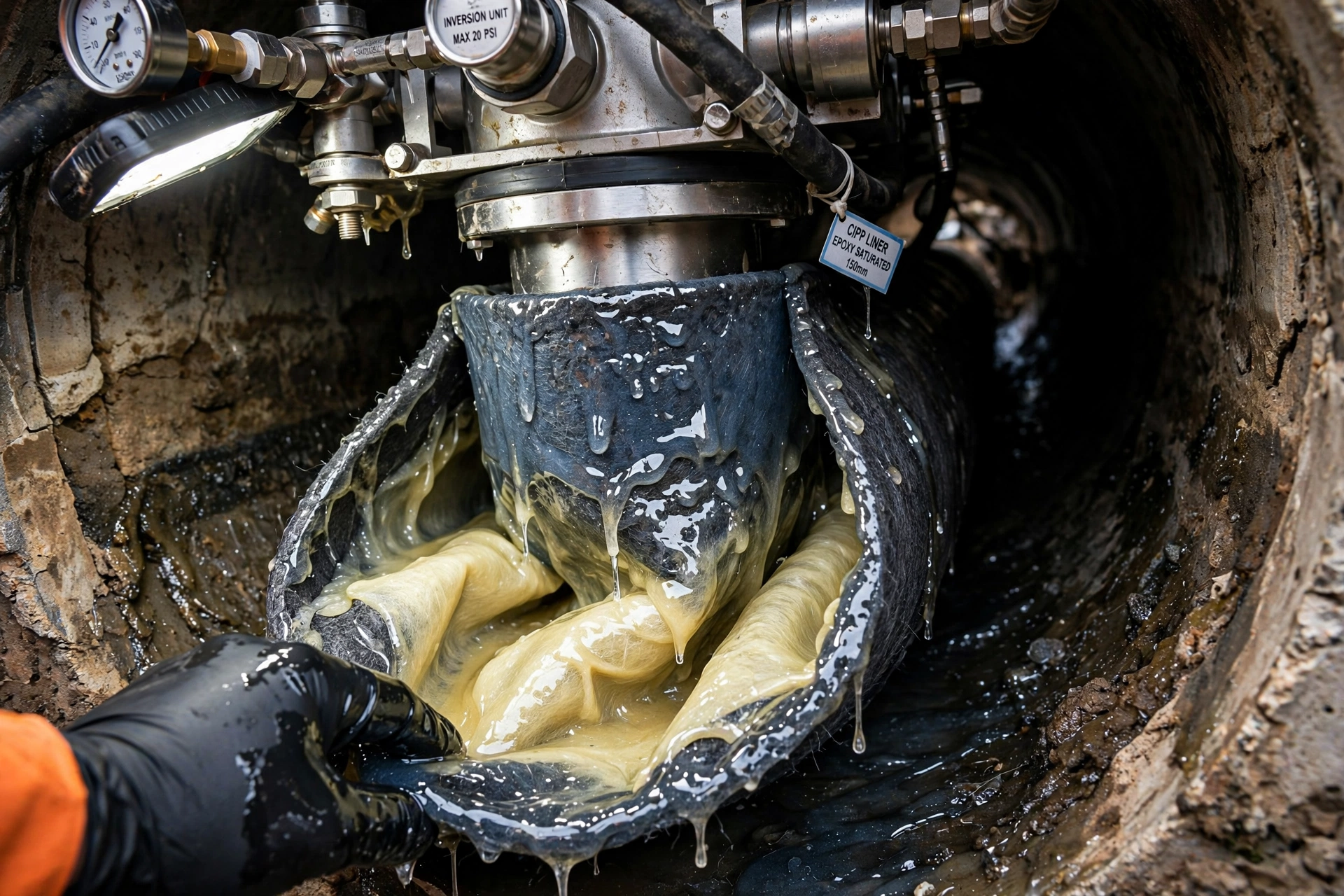
1. Cured-In-Place Pipe (CIPP) Lining — We insert a flexible liner saturated with epoxy resin into your existing damaged pipe, inflate it to press against the old pipe walls, and cure it with heat or UV light. The result: a seamless, jointless “pipe within a pipe” that’s structurally independent. The liner is typically 4-6mm thick and rated for 50+ years.
CIPP is ideal for: cracked pipes, root intrusion damage, corroded cast iron, offset joints, and general deterioration — as long as the old pipe still has its basic shape. Think of it as giving your pipe a new inner skin.
2. Pipe Bursting — We pull a bursting head through the old pipe, fracturing it outward, while simultaneously pulling a brand-new HDPE pipe into place behind it. The new pipe is full-diameter (or even upsized) and completely new material.
Pipe bursting is ideal for: collapsed sections, severely deformed pipe, situations where you want to upsize capacity, or when the old pipe is too far gone for a liner to bond properly.
Both methods start the same way: a camera inspection to map the exact condition, location, depth, and length of the damage. Anyone who quotes trenchless repair without a camera inspection first is guessing — walk away.
“Can You Really Fix It Without Digging?” — The Honest Answer
Yes — in about 70-80% of residential sewer problems. But here are the situations where trenchless won’t work and I’ll tell you straight:
- Complete collapse with soil intrusion: If the pipe has fully collapsed and dirt has filled the void, there’s nothing for a liner to follow. Pipe bursting might still work; lining won’t.
- Severe bellies (sagging sections): A liner follows the existing pipe shape. If the pipe has a deep sag where waste pools, the liner will have that same sag. Grading problems need excavation.
- Back-pitched pipe: Same issue — lining doesn’t fix slope problems. If the pipe was installed wrong, it needs to be reinstalled right.
- Too many sharp bends: Liners can navigate gentle bends but not 90-degree turns or extreme offsets.
This is why the camera inspection is non-negotiable. We show you the video, explain what we’re seeing in plain language, and recommend trenchless only when it’s genuinely the right fix. If your situation needs excavation, we’ll tell you that too — and we’ll do that job right as well.
Why California Homes Are Prime Candidates for Trenchless
California’s housing stock makes trenchless especially valuable here:
- Mature landscaping: Decades-old trees, established gardens, expensive hardscaping — the things that make California properties beautiful are exactly what traditional trenching destroys. Trenchless preserves all of it.
- Concrete and pavers everywhere: Driveways, patios, walkways, pool decks. Cutting and replacing concrete adds 3,000-8,000+ to a traditional dig. Trenchless avoids most of it.
- Clay soil and root intrusion: California’s clay soil shifts, stressing rigid pipes. Mature trees send roots into every available joint. CIPP lining creates a seamless pipe with no joints for roots to penetrate — it solves the root problem permanently, not just until the next growing season.
- Cast iron and Orangeburg: Many California homes built from the 1940s-1970s have cast iron or Orangeburg (bituminized fiber) sewer lines. Both deteriorate predictably — cast iron corrodes from the inside, Orangeburg deforms and collapses. Trenchless lining is often the perfect rehabilitation for these materials.
- Deep lines: Some California sewer laterals run 8-12 feet deep. Excavating that deep requires shoring, heavy equipment, and serious money. Trenchless doesn’t care about depth.
What Trenchless Sewer Repair Costs in California
Straight numbers:
- CIPP lining: 150-250 per linear foot. A typical 50-foot residential lateral runs 7,500-12,500.
- Pipe bursting: 175-275 per linear foot. A typical 50-foot run: 8,750-13,750.
- Camera inspection: 250-500 (often credited toward the repair if you hire us).
- Permits: 200-800 depending on your city.
Compare to traditional excavation: 100-200 per foot for the pipe work itself, plus 3,000-15,000+ in restoration (concrete, landscaping, irrigation, hardscaping). When you add it all up, trenchless is frequently cheaper in total project cost — and always less disruptive.
What affects the price: total length, pipe diameter, depth, access difficulty, number of connections that need reinstatement, and your city’s permit requirements. Our quote is one flat number in writing — the price we agree on is the price you pay.
The Process: What to Expect
- Camera inspection and mapping: We run a high-resolution camera through your line, record the full run, and show you exactly what’s wrong and where. You see what we see.
- Written proposal: Method recommendation (lining vs. bursting), linear footage, flat price, timeline. No pressure — take the video to get other quotes if you want.
- Permits: We pull the sewer repair permit from your city. This is required everywhere in California.
- Access points: We establish entry and exit points — usually through an existing cleanout, or we create small excavations (typically 3×3 feet) at each end. That’s it. No trench.
- Pipe preparation: We clean the old pipe thoroughly with hydro jetting and mechanical cutters. A liner only bonds well to a clean pipe — this step is critical and we don’t rush it.
- Liner installation or pipe bursting: The liner goes in, gets cured, and we verify with a post-installation camera inspection. For bursting, the new HDPE pipe is pulled through and connected.
- Connection reinstatement: Branch connections (from toilets, sinks) are reopened robotically from inside the new liner. We camera-verify every one.
- Final inspection and warranty: City inspection, final camera video for your records, and our warranty documentation. Most CIPP liners carry a 50-year design life; we back our workmanship in writing.
Timeline: most residential trenchless jobs complete in 1-3 days. You’ll have full sewer use restored quickly — often the same day the liner cures.
DIY Reality Check
There is no DIY version of trenchless sewer repair. The equipment costs tens of thousands of dollars, the epoxy chemistry requires training, and improper installation can block your line entirely — turning a repairable problem into an excavation emergency. This is also not a handyman job. In California, sewer line work requires a C-36 licensed plumbing contractor and a city permit. Unpermitted sewer work can cause major problems when you sell your home.
Trenchless Sewer Repair FAQs
How much does trenchless sewer repair cost in California?
CIPP lining runs 150-250 per linear foot; pipe bursting 175-275 per foot. A typical 50-foot residential lateral costs 7,500-13,750. When you factor in avoided restoration costs (concrete, landscaping), trenchless is often cheaper than traditional digging in total project cost.
How long does a trenchless liner last?
CIPP liners are engineered for a 50+ year design life. The epoxy creates a seamless, jointless, corrosion-proof pipe that’s actually stronger than many original pipe materials. We provide written workmanship warranty on every job.
Will trenchless work on my old cast iron or clay pipes?
Usually yes. Cast iron with internal corrosion and clay tile with root intrusion or cracked joints are ideal candidates for CIPP lining — as long as the pipe hasn’t fully collapsed. The camera inspection determines this definitively.
Does trenchless repair reduce my pipe diameter?
Minimally. A CIPP liner is 4-6mm thick, reducing diameter by less than half an inch on a 4-inch pipe. The smooth epoxy surface actually improves flow compared to corroded or scaled old pipe. If capacity is a concern, pipe bursting installs a full-diameter new pipe.
How do I know if I need trenchless repair vs. just cleaning?
If your drains back up repeatedly despite professional cleaning, if a camera shows cracks, breaks, root masses, or collapsed sections — that’s a repair situation, not a cleaning situation. Cleaning treats symptoms; trenchless fixes the pipe. We’ll show you the camera footage and give you an honest assessment.
Do you need to dig at all for trenchless?
We need small access points — typically 3×3 foot excavations at the entry and exit, or we use your existing cleanout. Compare that to a traditional trench running the full length of your yard. Your landscaping, driveway, and patio stay intact.
Is a permit required for trenchless sewer repair?
Yes, in every California city. We handle all permitting as part of the job. Be wary of any contractor who suggests skipping the permit — it creates problems at resale and with insurance claims.
Sewer Line Problems? See It Before You Fix It.
Free camera inspection review, honest trenchless assessment, flat-rate pricing. We’ll show you exactly what’s wrong and the least disruptive way to fix it.
Licensed C-36 • Upfront Pricing • Same-Day Service