
Sewer Line Repair & Replacement in California
Sewage backing up? Multiple drains clogged? Soggy spots in the yard? Our licensed plumbers diagnose sewer problems with HD cameras, clear blockages, and repair or replace damaged lines — including trenchless options that save your landscaping.
Get Your Free Quote
60 seconds · No obligation · Upfront pricing
The Signs Your Sewer Line Is Failing
Your sewer line is the one pipe you never think about until it ruins your week. It runs underground from your house to the city main or septic system, carrying everything away silently — until it doesn’t. Here’s what failure looks like from inside the house:
- Multiple drains backing up at once. This is the hallmark sign. One clogged sink is a fixture problem. The toilet, tub, and shower all backing up together means the blockage is in the main line they all share.
- Gurgling toilets and drains. Air trapped by a blockage bubbles back through fixtures. If your toilet gurgles when the washing machine drains, the main line is restricted.
- Sewage odors inside or outside. A persistent rotten smell from drains, or a foul patch in the yard, often means a cracked or broken line venting where it shouldn’t.
- Unexplained lush patches in the lawn. Sewage is fertilizer. If one section of your yard is suspiciously greener and soggier than the rest, there’s likely a leak feeding it.
- Slow drains throughout the house. When every fixture drains slowly — not just one — the restriction is downstream in the main.
- Frequent backups that keep returning. If you’ve had the line “cleared” twice in a year and it backs up again, cabling isn’t fixing the underlying problem. Something structural is wrong.
I’m not sure exactly where the problem is — and that’s completely normal. Most homeowners can’t see their sewer line (it’s buried 3–6 feet underground), and you shouldn’t have to diagnose it. That’s what the camera is for.
Why California Sewer Lines Fail
California has a perfect storm of sewer-killing conditions, and after decades working these lines, here are the real causes:
Tree roots — the #1 killer. Our mature landscaping is beautiful and brutal. Ficus, eucalyptus, oaks, and even smaller ornamentals send roots toward the moisture in sewer lines. Older clay pipes (common pre-1970) have joints every few feet — each joint is an entry point. Cast iron corrodes from the inside, creating rough spots roots grab onto. Once roots are in, they grow thicker, catch waste, and eventually choke the line completely. I’ve pulled root masses the size of a football out of 4-inch lines.
Age and material failure. Clay tile pipes crack and shift. Cast iron scales and corrodes from the inside until the pipe is paper-thin. Orangeburg (a tar-paper pipe used in the 50s–60s) literally deforms and collapses over time — if your California home was built in that era and still has original sewer, it’s living on borrowed time. Even early PVC can have bellied sections where the ground settled.
Ground shifting. California soil moves — expansive clay soils swell and shrink with moisture changes, earthquakes shift things, and poorly compacted trench backfill settles. All of this can separate joints, create bellies (low spots where waste collects), or crack rigid pipe.
What gets flushed. “Flushable” wipes are the bane of every sewer plumber’s existence — they don’t disintegrate like toilet paper. Feminine products, paper towels, and grease poured down kitchen drains all contribute to blockages that stress aging lines.

The Camera Doesn’t Lie: How We Diagnose
Here’s something you should know: any plumber who quotes you a sewer replacement without running a camera first is guessing. And guessing with your money. Our diagnostic process:
Step 1: HD camera inspection. We feed a waterproof camera through your sewer cleanout (or pull a toilet if there’s no cleanout) and record the entire run to the street. You watch the monitor with us. You’ll see exactly what we see — roots, cracks, bellies, collapsed sections, offsets. No technical jargon needed; a broken pipe is obvious on screen.
Step 2: Locate and measure. Our locator equipment traces the camera’s signal from above ground, so we know exactly where the problem is and how deep. This matters enormously — a break 3 feet deep under lawn is a very different job than a break 8 feet deep under your driveway.
Step 3: Honest options. Based on what the camera shows, we lay out your real choices: clearing, spot repair, trenchless lining, or full replacement. We show you the footage, explain the trade-offs, and let you decide. The recording is yours to keep — get a second opinion if you want. A legitimate plumber welcomes that.
Do we have the machines? Yes — and this is exactly the equipment question to ask. HD push cameras, self-leveling heads, 200+ foot reels, electronic locators, hydro jetters, and trenchless lining equipment. If a company wants to dig up your yard based on a “feeling,” get another quote.
Repair Options: From Least to Most Invasive
Not every sewer problem needs a full replacement. Here’s the honest spectrum:
Mechanical clearing (cabling): For root intrusion or soft blockages in an otherwise sound pipe. We cut through the obstruction with rotating blades. Cost: $350–$900. Lasts 1–3 years for roots (they grow back) — think of it as management, not a cure.
Hydro jetting: High-pressure water scours the pipe interior, cutting roots and flushing debris. More thorough than cabling, restores near-full diameter. Cost: $500–$1,200. Best for grease buildup and moderate root intrusion in structurally sound pipe.
Spot repair: When the camera shows one bad section — a single crack, offset joint, or short collapsed area — we excavate just that spot and replace it. Cost: $2,000–$5,000 depending on depth and location. Makes sense when the rest of the line is in good shape.
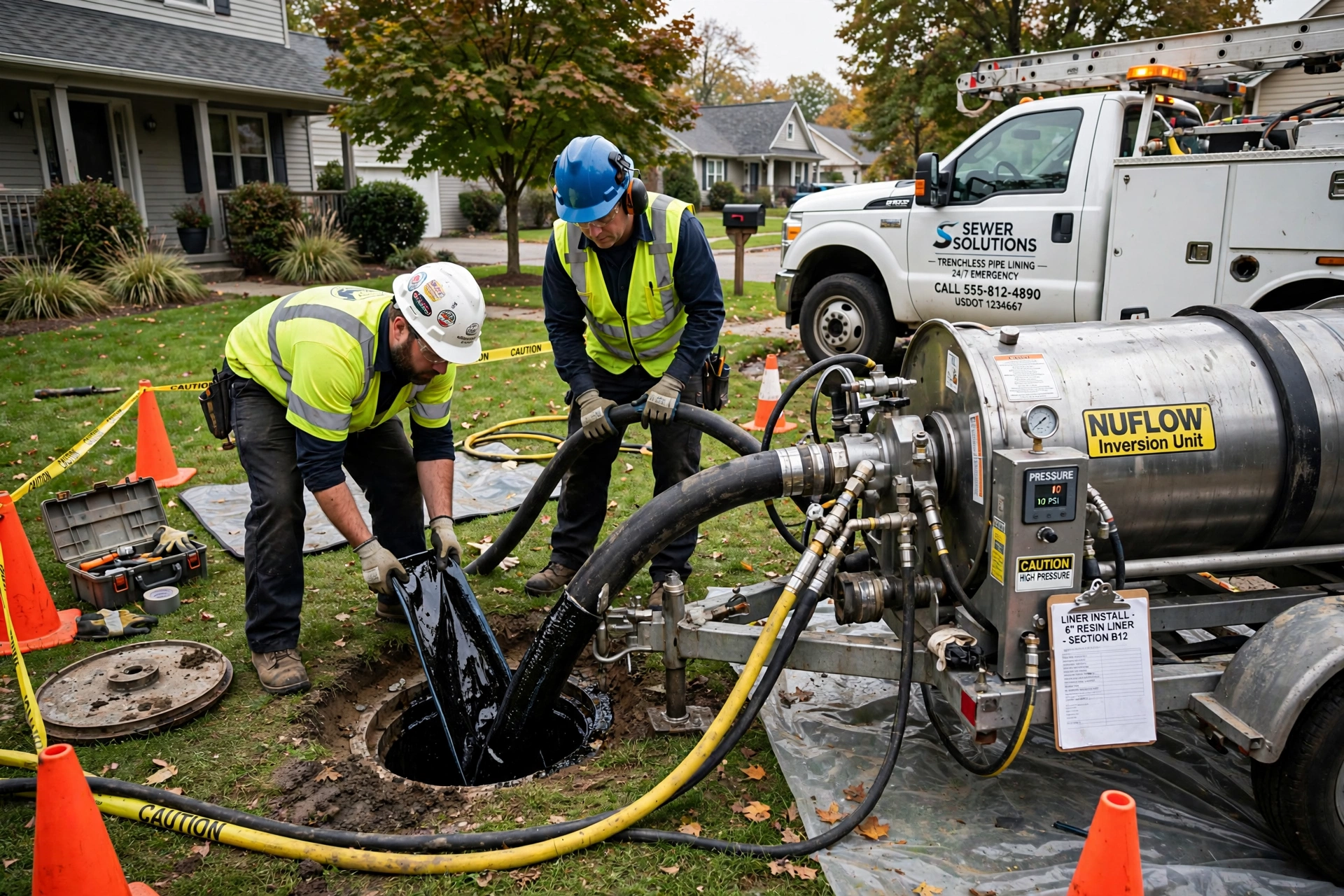
Trenchless pipe lining (CIPP): We install a resin-saturated liner inside the existing pipe, which hardens into a new pipe within the old one. Minimal digging — usually just access pits. Cost: $5,000–$12,000 depending on length. Lasts 50+ years. Ideal when the old pipe is mostly intact but has cracks, root entry points, or minor offsets. Won’t work on fully collapsed sections or severe bellies.
Pipe bursting (trenchless replacement): We pull a new HDPE pipe through the old line, fracturing the old pipe outward. New pipe, minimal excavation. Cost: $6,000–$15,000. Works even on collapsed pipe where lining can’t.
Traditional excavation and replacement: Open trench, remove old pipe, install new PVC or ABS. Cost: $5,000–$20,000+ depending on length, depth, and what’s above it (landscaping vs. driveway vs. structures). Sometimes it’s the only option — severe collapse, extreme bellies, or rerouting needs.
Sewer Line Costs — Honest Numbers
Sewer work is the most expensive plumbing there is, so let’s be straight about it. California ranges:
- Camera inspection: $150–$350 standalone (we credit it toward repair work)
- Main line clearing: $350–$900
- Hydro jetting: $500–$1,200
- Spot repair: $2,000–$5,000
- Trenchless lining: $5,000–$12,000
- Full replacement: $5,000–$20,000+ depending on length, depth, method, and surface restoration
What drives cost: depth (deeper = more excavation), length of run, what’s on the surface (a lawn is cheap to restore; a stamped concrete driveway is not), permit requirements (most California cities require permits for sewer replacement), and whether the city-side connection needs work. We provide the camera footage, a written scope, and one flat price. For jobs over $5,000, we also explain financing options — because nobody budgets for a sewer line.
Trenchless vs. Traditional: An Honest Comparison
Trenchless sounds better — and often is — but it’s not always the answer. Here’s my straight take:
Choose trenchless when: the pipe is structurally mostly intact (cracks, root intrusion, minor offsets), you want to preserve landscaping/driveways/patios, and the cost premium over digging is justified by avoiding surface restoration. Lining adds 50+ years of life with minimal disruption.
Choose traditional excavation when: the pipe is fully collapsed, has severe bellies (low spots that hold waste — lining follows the belly and doesn’t fix the grade problem), needs rerouting, or is too damaged for a liner to bond properly. Sometimes digging is simply the right engineering answer.
Watch out for: companies that only sell trenchless and recommend it for everything, or companies that only dig and dismiss trenchless. The right method depends on what the camera shows. We do both, so our recommendation is based on your pipe — not our equipment inventory.
The DIY Reality Check
Sewer lines are 3–6 feet underground, require permits, involve heavy equipment, and connect to municipal systems. There is no meaningful DIY here, and attempting it can create liability with your city. What you CAN do: know where your sewer cleanout is (usually a capped pipe near the house or property line — if you don’t have one, have us install it; it makes every future service cheaper), don’t flush wipes or grease, and consider root treatment products as maintenance between professional cleanings (copper sulfate-based root killers can slow regrowth — they’re management, not a fix).
If a neighbor or handyman offers to “replace your sewer line cheap, no permit needed” — run. Unpermitted sewer work can fail city inspection when you sell, create liability if it damages the municipal main, and usually means no warranty when it fails.
Preventing Sewer Disasters
- Camera inspection every 2–3 years if you have mature trees near your line or a home built before 1980. Catching root intrusion early is a $500 maintenance clearing instead of a $10,000 replacement.
- Only flush the 3 P’s: pee, poop, and (toilet) paper. Everything else goes in the trash.
- Grease goes in the trash, not the drain. It solidifies in the main line and catches everything behind it.
- Know your cleanout location. In an emergency backup, fast cleanout access saves time and money.
- Consider a backwater valve if your home is downhill from the street or in a flood-prone area — it prevents city sewer surcharges from backing into your home.
Sewer Line FAQs
How much does sewer line replacement cost in California?
Full replacement ranges from $5,000 to $20,000+ depending on length, depth, method (trenchless vs. excavation), and surface restoration. Trenchless lining runs $5,000–$12,000. We provide camera footage, a written scope, and one flat upfront price.
How do I know if my sewer line is broken or just clogged?
You can’t tell from symptoms alone — that’s what the camera is for. Recurring backups after clearing, sewage smells, soggy yard patches, and simultaneous multi-fixture problems suggest structural damage. A $150–$350 camera inspection gives you a definitive answer with video proof.
What is trenchless sewer repair and does it work?
Trenchless methods (pipe lining or pipe bursting) repair or replace your sewer with minimal digging. Lining creates a new pipe inside the old one; bursting pulls new pipe through while fracturing the old. Both last 50+ years when properly installed. They don’t work on fully collapsed pipe or severe bellies — the camera determines candidacy.
Tree roots keep growing into my sewer line — what are my options?
Short-term: professional root cutting ($350–$900) every 1–3 years, plus root treatment products between visits. Long-term: trenchless lining seals every joint so roots can’t enter, or full replacement with root-resistant pipe. If you’re clearing roots twice a year, the math favors a permanent fix.
Will you show me the camera footage?
Absolutely — you watch live during the inspection, and we provide the recording. Any plumber who won’t show you the inside of your own pipe is asking you to take their word for a $10,000 recommendation. Don’t.
Does homeowners insurance cover sewer line replacement?
Standard policies typically exclude sewer line wear and tear, but many offer a “service line” rider for $30–$60/year that covers it. Check your policy — if you have an older line, that rider is some of the cheapest insurance you’ll ever buy.
How long does sewer line replacement take?
Trenchless jobs: 1–2 days. Traditional excavation: 2–5 days depending on length and depth. We coordinate permits and inspections, and you’ll have full plumbing function restored each evening during multi-day jobs whenever possible.
Sewer Problems? Get the Camera Truth First.
HD camera inspection, honest options, upfront pricing. Call now for sewer diagnosis anywhere in California.
Licensed C-36 • HD Camera Inspection • Trenchless Options