
Water Heater Repair & Installation in California
No hot water? Rusty water? A tank that’s leaking or making strange noises? Our licensed plumbers repair all major brands and install new high-efficiency tank and tankless water heaters — sized right for your home and installed to California code.
Get Your Free Quote
60 seconds · No obligation · Upfront pricing
No Hot Water? Here’s How a Plumber Thinks About It
You turn on the shower, wait, and… lukewarm. Or nothing. Or the water starts hot and goes cold in five minutes. Before you assume the worst, here’s how I diagnose it — because the fix ranges from a $30 part to a full replacement, and knowing the difference saves you real money.
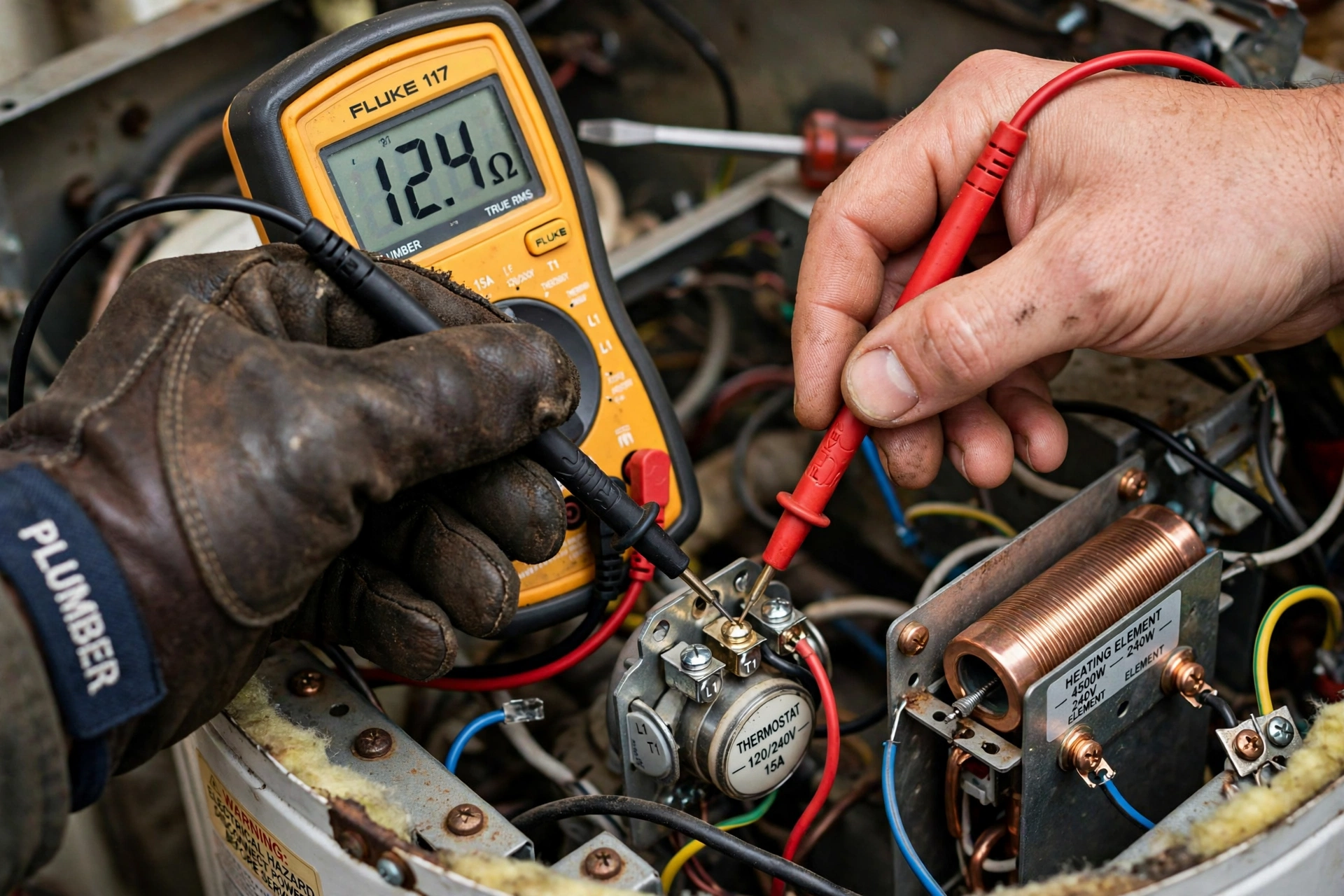
If you have NO hot water at all: On a gas heater, the pilot light may be out or the thermocouple (the little safety sensor that tells the gas valve the pilot is lit) has failed. On electric, it’s usually a tripped breaker, a failed heating element, or a dead thermostat. These are the most common “no hot water” calls I get, and most are repairable in under an hour.
If hot water RUNS OUT fast: On a gas unit, this often means heavy sediment buildup — California’s hard water leaves mineral deposits that pile up on the tank bottom, insulating the water from the burner. The burner runs longer, the tank overheats in spots, and you get less usable hot water. On electric, one of the two heating elements has usually failed, so you’re running on half capacity.
If the water is RUSTY or smells: Rusty hot water (but clear cold) means the tank’s interior lining and anode rod are failing — the tank is rusting from the inside. A rotten-egg smell is bacteria reacting with the anode rod in warm water. Both are signs the tank is aging out.
If there’s WATER around the base: Check whether it’s coming from the tank itself or from a fitting above (a leaking supply connection or the temperature-and-pressure relief valve can drip down and fool you). Water from the tank body itself means replacement — tanks can’t be patched reliably.
Repair or Replace? The Honest Math
This is the question every homeowner asks, and I’ll give you the same rule I use for my own house: if the repair costs more than half the price of a new unit and the tank is over 8 years old, replace it. Here’s why that math works:
A standard tank water heater lasts 8–12 years in California (hard water shortens it). The tank itself is the expensive part — once it starts leaking from the body, there’s no economical fix. But the components around it — thermocouples, gas valves, heating elements, thermostats, T&P valves — are all replaceable and relatively cheap. A 5-year-old tank with a bad thermocouple? Repair it for $200 and get five more years. An 11-year-old tank with a failing gas valve? That $400 repair is throwing money at a tank that’s already on borrowed time.
Here’s what I check on every service call: the manufacture date (stamped on the rating plate), the condition of the anode rod port, signs of prior leaking, and the state of the venting and gas connections. Then I give you both numbers — repair cost and replacement cost — and my honest recommendation. If repair makes sense, I’ll tell you. I’d rather earn your trust with a $200 repair today than sell you a $2,500 replacement you don’t need.
Tank vs. Tankless: What a Plumber Actually Recommends
Everyone’s heard tankless is “better.” The truth is more nuanced, and it depends on your house:
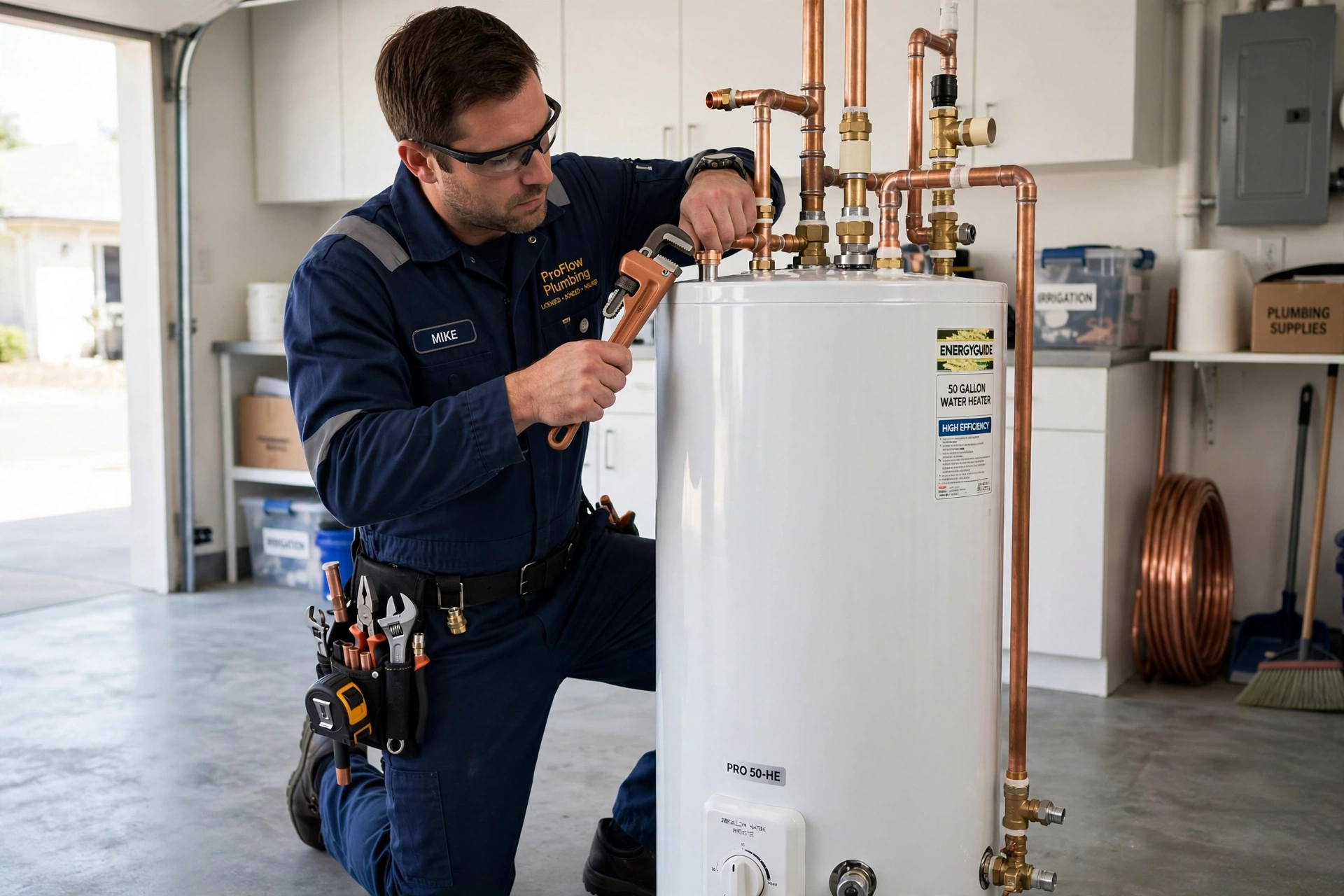
Traditional tank (40–50 gallon): Lower upfront cost ($1,800–$3,500 installed), simple technology, any plumber can service it, works during power outages (gas models). Downsides: standby heat loss (you’re paying to keep 50 gallons hot 24/7), limited supply (back-to-back showers can run it out), and the flood risk when the tank eventually fails. For most California homes, a quality tank with a 6–9 year warranty is the practical, economical choice.
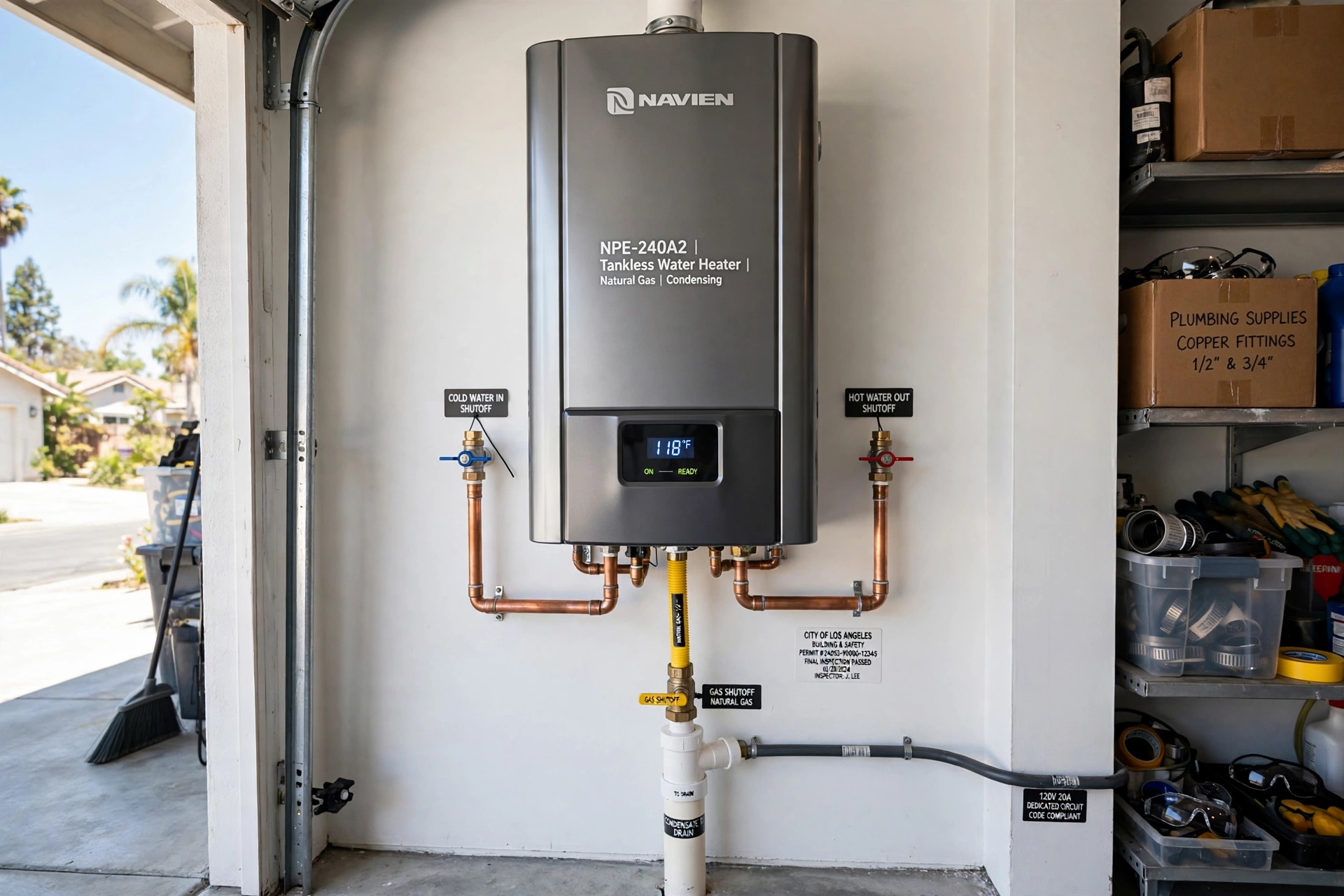
Tankless (on-demand): Endless hot water, 20+ year lifespan, wall-mounted (frees up floor space), 25–35% more energy efficient. But: higher upfront cost ($3,500–$6,500 installed — they often need gas line upsizing and new venting), “cold water sandwich” effect (brief cold bursts), minimum flow requirements (a trickling faucet may not trigger it), and they need annual descaling in hard water areas or the heat exchanger fails prematurely. In California’s hard water, skip the maintenance and you’ll kill a $4,000 unit in 5 years.
My honest take: If you have a large household that constantly runs out of hot water, or you’re tight on space, tankless is worth it — but budget for the maintenance. If your needs are normal and your budget matters, a high-efficiency tank gives you the best value per dollar. What I won’t do is push tankless on everyone to pad the ticket. The right answer depends on your house, your water, and your wallet.
What a Proper Installation Includes (California Code)
California has some of the strictest water heater codes in the country, and for good reason — we’re in earthquake country. A proper installation isn’t just swapping the tank; here’s what code requires and what we do on every job:
- Seismic strapping: Two earthquake straps securing the tank to wall studs — upper and lower third. This is non-negotiable in California and the #1 thing handyman installs skip.
- Expansion tank: Required on closed systems (most homes with a pressure regulator or check valve). Absorbs thermal expansion so pressure doesn’t spike and damage your plumbing.
- T&P relief valve with proper discharge: The temperature-and-pressure valve must drain to within 6 inches of the floor or to the exterior — not just capped off.
- Drip pan with drain: Required when the heater sits where a leak could cause damage (interior closets, above living space).
- Proper venting: Gas units need correct vent sizing, slope, and clearance from combustibles. Improper venting is a carbon monoxide risk — this is life-safety stuff.
- Permit and inspection: Most California jurisdictions require a permit for water heater replacement. We pull it and handle the inspection.
If someone offers to install your water heater for $800 cash with no permit, they’re skipping most of this list. When that unstrapped tank tips over in an earthquake and floods your house — or worse — the savings won’t seem worth it.
Water Heater Costs — Honest Numbers
Here’s what water heater work actually costs in California, installed to code with permits:
- Diagnostic visit: $89–$150 (credited toward repair or replacement)
- Common repairs: Thermocouple $175–$275 · Heating element $200–$350 · Thermostat $200–$300 · Gas valve $350–$550 · T&P valve $175–$275
- Standard 40–50 gal tank replacement: $1,800–$3,500 depending on brand, warranty length, and code upgrades needed (expansion tank, venting, pan)
- High-efficiency / power-vent tank: $2,500–$4,500
- Tankless installation: $3,500–$6,500 (higher if gas line upsizing or new venting is required)
- Annual maintenance (flush + anode check): $150–$250
What drives replacement cost up: bringing an old installation up to current code (very common — the old heater was installed before expansion tanks were required), relocating the unit, gas line upgrades for tankless, and difficult access (attic or tight closet installs take longer). We quote the full job upfront — unit, parts, labor, permit, haul-away of the old tank — one number, no add-ons later.
Why California Water Heaters Die Young
Our water is hard — dissolved minerals, mostly calcium and magnesium. Inside your tank, every heating cycle bakes those minerals into sediment that settles on the bottom. Here’s what that sediment does:
On gas heaters, it forms an insulating layer between the burner and the water. The burner runs longer and hotter to heat through it, which overheats the tank bottom and accelerates metal fatigue. You’ll hear it — that rumbling, popping, or crackling sound is water boiling trapped under sediment. Plumbers call it “kettling,” and it’s the sound of your tank dying.
On electric heaters, sediment buries the lower heating element, which overheats and burns out prematurely. Then you’re running on one element, wondering why the shower goes cold.
The anode rod is your tank’s sacrificial protector — a magnesium or aluminum rod that corrodes so the tank doesn’t. In hard water it depletes faster. Once it’s gone, the tank starts corroding. Checking it every 2–3 years and replacing it ($200–$300) can add years to your tank’s life. Almost nobody does this, which is why the average tank dies at 9 years instead of 12+.
The DIY Reality Check
Water heaters involve gas lines, 240-volt electricity, scalding water under pressure, and carbon monoxide venting. This is not a DIY appliance, and California code agrees — permits and licensed installers are required for good reason.
What you CAN do: relight a pilot following the manufacturer’s instructions (if you’re comfortable and there’s no gas smell). Drain a few gallons from the tank annually to reduce sediment (attach a hose to the drain valve, run it to a safe drain). Test the T&P valve yearly by lifting the lever briefly — water should flow and stop. Check for moisture around the base monthly.
What you should NOT do: replace a gas valve, mess with gas connections, install a new unit yourself, or ignore a leaking tank “until the weekend.” A leaking tank doesn’t get better — it gets worse, usually at the worst possible time. And please don’t cap off a dripping T&P valve — that valve is the only thing preventing a pressure explosion. It’s dripping for a reason; find the reason.
Water Heater FAQs
How much does it cost to replace a water heater in California?
A standard 40–50 gallon tank replacement runs $1,800–$3,500 installed to code with permits. Tankless runs $3,500–$6,500. The range depends on code upgrades needed, access difficulty, and whether gas or venting modifications are required. We quote one flat price upfront.
How do I know if my water heater needs replacing?
Key signs: it’s over 10 years old, rusty hot water, rumbling/popping noises, water pooling around the base, or frequent repairs. Water leaking from the tank body itself (not a fitting) means replacement — tanks can’t be reliably patched.
Should I get a tankless water heater?
It depends. Tankless gives endless hot water and lasts 20+ years, but costs more upfront and needs annual descaling in California’s hard water. For large households or tight spaces, it’s worth it. For normal needs, a quality tank is better value. We’ll give you an honest recommendation based on your home — not a sales pitch.
My water heater is making rumbling noises — is that bad?
That’s sediment buildup — water boiling trapped under mineral deposits on the tank bottom. It’s common in California’s hard water and means the tank is working harder than it should. A professional flush can help if caught early; if the tank is old, it’s a sign replacement is approaching.
How long does installation take?
A standard tank replacement takes 2–4 hours including code upgrades and permit paperwork. Tankless installations take a full day or more due to gas and venting modifications. We haul away the old unit.
Do I need a permit to replace my water heater?
In most California cities, yes. We pull the permit and schedule the inspection as part of every replacement — it’s included in our quote, not an add-on.
My pilot light keeps going out — what does that mean?
Usually a failing thermocouple — a $175–$275 repair. It could also indicate venting issues or a failing gas valve. If the unit is over 10 years old and this is one of several problems, it may be time to discuss replacement.
Hot Water Problems? Let’s Fix Them Today.
Repair or replacement — honest diagnosis, upfront pricing, code-compliant installation. Call now anywhere in California.
Licensed C-36 • Tank & Tankless • Upfront Pricing