Tree Roots in Your Sewer Line? Signs & Solutions
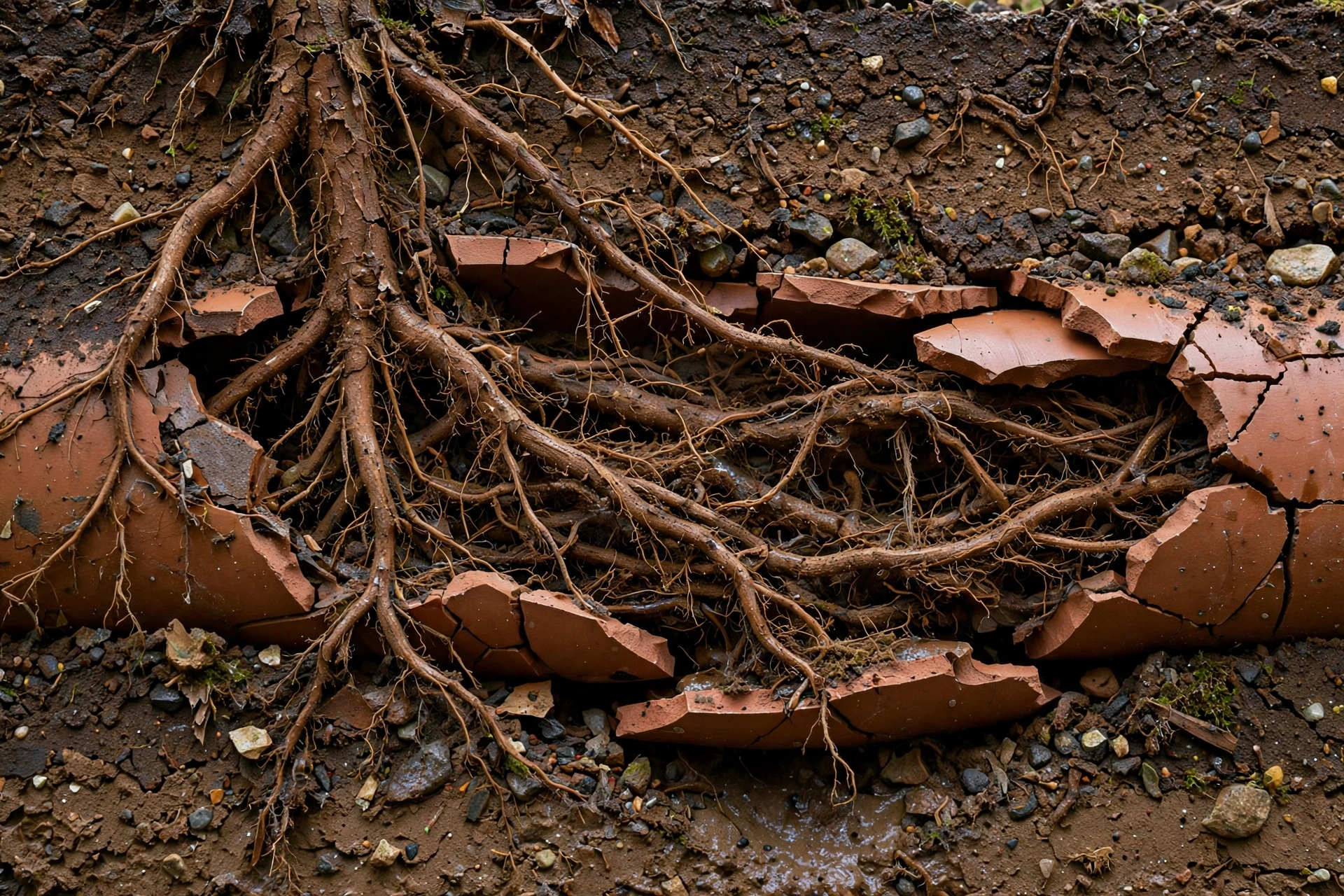
California is root-intrusion capital, and it’s not close. Mature trees, old clay sewer laterals, and dry summers that send roots hunting for moisture — it’s the perfect setup. A pencil-thin root finds a hairline crack or loose joint, slips inside for the water, and grows. Give it a couple of years and you’ve got a root mass the size of a football choking your main line.
Here’s how to tell it’s happening, and what actually fixes it.
Sign #1: Drains Slowing Down All Over the House
One slow bathroom sink is a local clog. Every drain in the house running slow — tubs, toilets, kitchen sink — means the restriction is in the main line they all share. Roots don’t block the pipe overnight; they narrow it gradually, so you get months of “the shower’s been draining slow lately” before the real trouble starts.
If flushing the toilet makes the tub gurgle, that’s the main line talking.
Sign #2: Clogs That Keep Coming Back
A root mass snags everything that passes: toilet paper, grease, the occasional “flushable” wipe. You clear the clog, flow returns, and three months later it’s back. If you’re on a first-name basis with your drain snake, roots are a prime suspect.
Chemical drain cleaners won’t dissolve a single root — and the harsh ones damage old pipes trying. Mechanical clearing is the only answer, which is what hydro jetting is built for: high-pressure water with a root-cutting nozzle.
Sign #3: Gurgling and Odd Drain Behavior
Gurgling is air trapped by a partial blockage forcing through water — toilets bubbling when the washer drains, sinks gurgling after a flush. Easy to ignore, expensive to ignore.
Sign #4: Lush or Soggy Patches in the Yard
A sewer lateral leaking nutrient-rich water into the soil fertilizes whatever’s growing above it. One suspiciously green, fast-growing strip of lawn — especially between your house and the street, where the lateral runs — is worth investigating. Soggy ground or a faint sewage odor in the yard is the advanced version of the same clue.
How a Plumber Confirms It: The Camera
Symptoms suggest, but a camera proves. A sewer camera inspection sends a camera through your cleanout and shows the inside of the line on video: the root mass, the crack or joint it entered through, and the pipe’s overall condition. This matters because the right fix depends on what the camera sees — a small intrusion in an otherwise sound pipe gets a different answer than roots pouring through a collapsed clay section.
Solution #1: Cut Them Out (Hydro Jetting)
For roots in a structurally sound pipe, hydro jetting cuts the intrusion out and scours the line. It’s fast, it’s thorough, and it buys years — but understand what it is: root removal, not root prevention. The crack or joint is still there, and roots grow back. Most plumbers are honest that jetting is maintenance on a line with an entry point, typically needed every couple of years depending on the tree and the pipe.
Solution #2: Fix the Entry Point (Trenchless Repair)
If the camera shows a sound pipe with isolated damage — a cracked section, a bad joint — trenchless sewer repair can rehabilitate the line from the inside without digging up your yard. A liner or a pipe-bursting head seals the entry points roots were using, which solves the actual problem rather than scheduling the next cutting.
Solution #3: Replace the Line
Collapsed clay, Orangeburg pipe that’s deforming, or a lateral that’s more patch than pipe — at some point replacement is the honest answer. Modern PVC or HDPE laterals with properly sealed joints give roots nothing to exploit. It’s the biggest-ticket option and the most permanent one. Our sewer line repair and replacement team walks homeowners through the camera footage so you can see exactly what you’re paying to fix.
What About Prevention?
You can’t stop a thirsty ficus from trying, but don’t plant aggressive-rooted trees near your lateral’s path — and know where the line runs before you landscape. Root barriers — physical shields buried between trees and the line — help with new plantings. And those copper sulfate products sold as root killers? They can slow regrowth between cleanings in some cases, but they won’t clear an established blockage, and heavy use isn’t great for the treatment plant downstream. Treat them as a maybe, not a plan.
When to Call a Plumber
Call when more than one drain is slow, when clogs recur, or when you see the yard signs. A camera inspection is the right first step — it’s inexpensive relative to any repair, and it turns guessing into knowing. If sewage is backing up into the house, skip the diagnosis queue: that’s urgent.
Frequently Asked Questions
How do tree roots get into sewer pipes?
Through any opening: cracks, loose joints in clay pipe, or separations from soil movement. Roots detect the moisture and nutrients leaking from the pipe and grow toward it — a root hair can enter a crack thinner than a credit card, then expand inside where there’s endless water.
Will hydro jetting permanently remove roots?
No. Jetting removes the intrusion completely, but the entry point remains, so regrowth is a matter of time — typically one to three years depending on the tree species and pipe condition. Permanent means fixing the pipe: lining or replacement.
Which trees are worst for sewer lines?
In California: ficus (the champion offender), willows, elms, liquidambars, and large pines. But any mature tree within 20-30 feet of a clay lateral is a candidate. The pipe material matters as much as the tree — modern sealed PVC shrugs off what destroys old clay.
Does homeowners insurance cover root damage?
Usually not for the pipe repair itself — gradual root intrusion is considered maintenance. Some policies cover resulting water damage to the home, but the lateral fix is typically out of pocket. Worth a call to your agent before assuming either way.