Banging Pipes? Water Hammer Explained & Fixed
Your washing machine finishes filling and — BANG — something slams inside the wall. Or the dishwasher stops and the pipes shudder like they got punched. That violent bang has a name: water hammer. And it’s not just noise. It’s a pressure spike hitting your pipes with real force, over and over, every day.
Here’s what’s happening, and how to stop it.
What Water Hammer Actually Is
Water is heavy, and when it’s moving through your pipes it carries momentum. When a valve slams shut, all that moving water has to stop instantly — and it piles up against the closed valve in a pressure wave. That wave is water hammer. It can momentarily spike pressure to several times normal — that’s the bang and the shudder.
Occasional gentle knocking is one thing. Loud, violent banging every time an appliance runs is your plumbing telling you it’s taking damage: loosened joints, cracked fittings, and eventually a burst connection inside a wall.
Cause #1: Fast-Closing Valves
The biggest culprit in modern homes is the solenoid valve — the electric valve inside washing machines, dishwashers, and some refrigerator ice makers. Unlike a hand-turned faucet that closes gradually, a solenoid snaps shut in a fraction of a second. Full flow to zero flow instantly is exactly the recipe for water hammer.
That’s why the bang so often syncs with the washing machine — it fills in bursts, and every burst ends with a snap.
Cause #2: Water Pressure That’s Too High
Water hammer hits harder when the water is moving faster — and water moves faster under higher pressure. If your household pressure is up near 80 psi or beyond, every valve closure lands like a bigger punch. Taming the pressure often tames the bang along with it.
California homes are prime candidates for this double problem, since many municipal supplies run hot and plenty of older homes have tired regulators. A $10 gauge on a hose bib tells you in thirty seconds whether pressure is part of your story.
Cause #3: Loose or Poorly Supported Pipes
Pipes are supposed to be strapped firmly to framing every few feet. When straps loosen, break, or were never installed properly — common in older California homes and quick remodels — the pipe itself moves when the pressure wave hits. That movement is the visible shudder, and it makes the noise dramatically worse while working joints loose over time.
If you can see pipe movement on an exposed run while someone triggers the bang, support is part of the problem.
Cause #4: Old Waterlogged Air Chambers
Older homes sometimes have air chambers — short vertical stubs of capped pipe installed near fixtures to cushion the shock. They worked fine when new, but over years the trapped air dissolves into the water and the chamber fills completely. A waterlogged chamber cushions nothing. If your house has them and the hammer developed gradually over years, this is a likely story.
The Real Fix: Water Hammer Arrestors
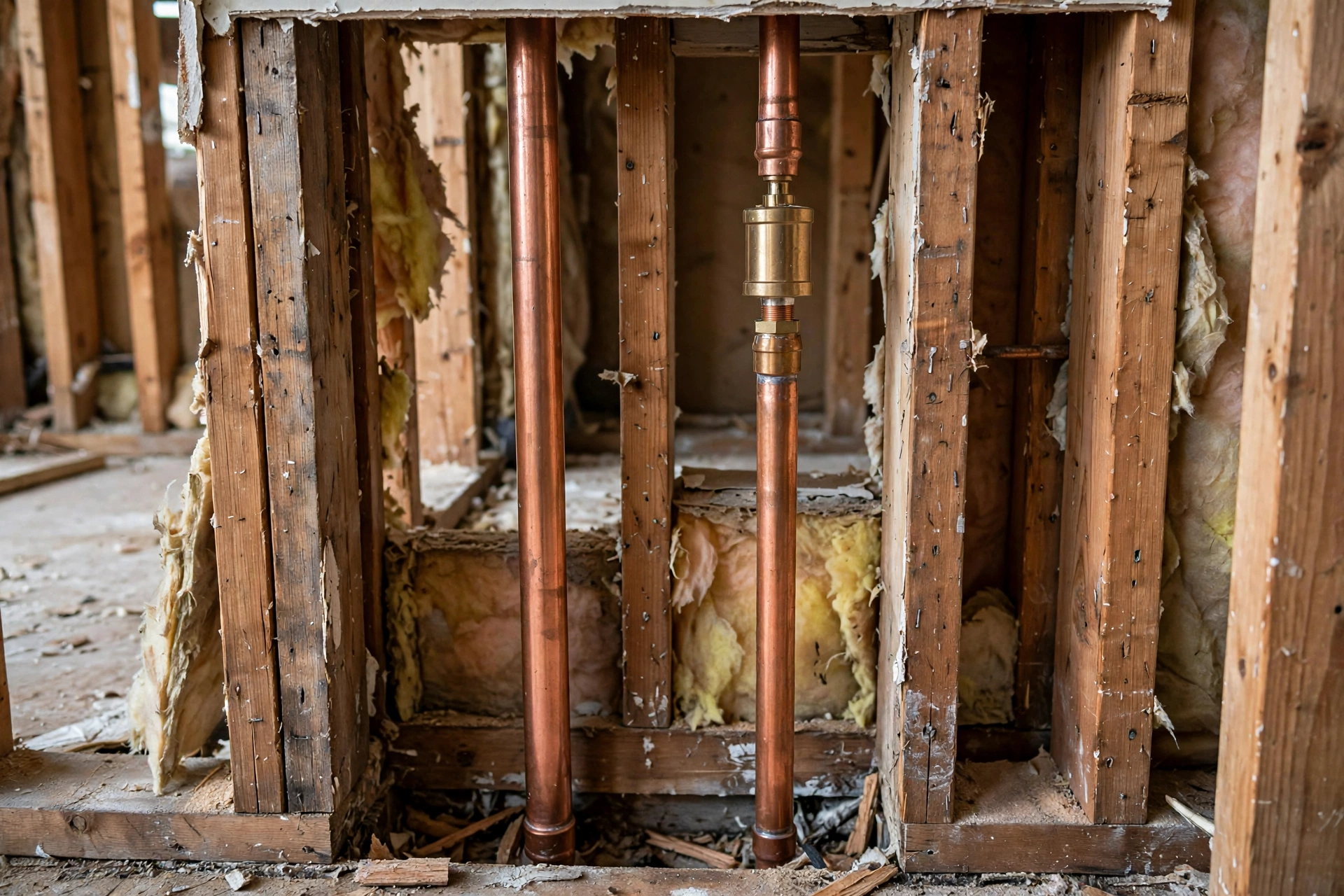
The modern solution is a water hammer arrestor: a small sealed cylinder with a piston and an air cushion inside that absorbs the shock wave. Unlike old air chambers, arrestors are sealed — the air can’t dissolve away, so they keep working for years.
Placement matters. Arrestors go as close as possible to the fast-closing valve causing the trouble — on the washing machine supply lines, at the dishwasher connection, near the problem toilet. Screw-on arrestors that thread directly onto washing machine valves are a genuine DIY job: shut off the valves, thread them on, reconnect the hoses. For arrestors that need to be soldered into supply lines inside walls, that’s plumber work.
Other Fixes Worth Doing
Arrestors handle the symptom at the valve, but don’t ignore the system around it. If your pressure tests above 80 psi, get it regulated — California code requires it anyway, and lower pressure means gentler hammer everywhere. Secure any loose pipe runs you can reach. And if an old toilet fill valve snaps shut violently, replacing it with a modern slow-closing valve can quiet that fixture entirely.
What doesn’t work: turning down the fixture’s supply valve to reduce flow. It slightly softens the bang but starves the appliance and doesn’t fix the underlying shock.
When to Call a Plumber
Try the washing machine arrestors yourself — they’re cheap and easy. Call a plumber when the banging is violent or house-wide, when arrestors at the obvious fixture don’t solve it, when pipes need securing inside walls, or when pressure testing shows high pressure that needs a regulator. And if a hammer event has already caused a leak — a burst supply line or a spraying connection — shut the main off and call an emergency plumber right away. If your home still has original galvanized or aging copper with chronic hammer, it may also be worth discussing water line replacement before the pipes make the decision for you.
Frequently Asked Questions
Is water hammer dangerous?
To people, no — but to plumbing, yes. Repeated pressure spikes fatigue joints and fittings. The risk isn’t the noise; it’s a connection failing inside a wall at 2 AM. Take persistent hammer seriously.
Why does only my washing machine cause banging?
Because its solenoid valves close faster than any hand-operated faucet. The washer fills in repeated bursts, so you get repeated hammer events. Arrestors on the washer supplies fix the large majority of these cases.
Will lowering my water pressure stop water hammer?
It helps — lower pressure means less momentum and a softer shock — but it rarely eliminates hammer from fast-closing solenoids on its own. Think of pressure control as the foundation and arrestors as the targeted fix. You usually want both.
How long do water hammer arrestors last?
Quality arrestors last many years, often a decade or more, since the air chamber is sealed. If banging returns years after an arrestor install, the arrestor itself may have failed — they’re replaceable.